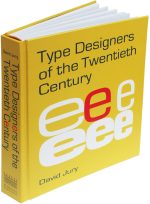
Mid-century Type: Typography, Graphics, Designers
author: David Jury
designer: Nicola Dennis
publisher: Merrill Books
date: 2023
Explores how, in the middle decades of the last century, the typographer became an independent, influential contributor to a fast-developing technological world of communications.

Reviewed by Simon Esterson
Eye Magazine, 2025
Putting the stories together
Don't be misled by the title of David Jury's book Mid-Century Type. It is not really just about type design in the 1950s, but rather a wide-ranging attempt to chart the graphic design landscape between the end of the Second World War in 1945 until the late 1960s, largely through the perspective of type and typography. Jury has done that difficult task of writing a join-the-dots narrative history that is international in scope, wears its scholarship lightly and has a strong selection of images of the design work under discussion.
At a time when very good books are published about the history of a single typeface, or are polemics about the relationship between graphic design and capitalism, Jury's approach is refreshingly traditional: this is an overview of a period where we may know parts of the story but maybe don't appreciate the overall context and connections. This is a period of print (people are designing letterheads that will be sent in the post), but also the time when graphic design emerged as an independent job. Now you didn't have to work for a printer, you could be a freelancer, although as Jury points out, in the early 1960s a typographer was mostly still drawing up specifications for the typesetter and 'never came into physical contact with the type."
Overall, Jury's story is about the rise of Modernism as reflected in graphic design. He puts it in the context of changing technologies – from metal type to photosetting and Letraset, from letterpress to litho – and in changing economics, including the rise of the United States, manufacturing and the advertising industry.
Given the scope of the period this is inevitably a rapid tour featuring many of the familiar figures. Tackling the subject through ten design areas, we see the rise of Swiss Modernism and its international manifestations (typically sans serif type, asymmetric layout and a preference for photography over illustration) through the work of, among many others, Paul Rand in the US, Adrian Frutiger in France, Josef Müller-Brockmann in Switzerland and Romek Marber in the UK.
And we also see the exceptions: Jan Tschichold's return to symmetrical typography in his 1940s work at Penguin, the wonders of Polish poster design and the retro style of Milton Glaser's Push Pin Studios in New York. It was also the age of corporate identity and the birth of the design group. When F H K Henrion was asked in 1962 by Dutch visitors why the Dutch airline KLM had come to his London design consultancy for a redesign rather than a Dutch designer, he replied: 'Institutions like to talk to institutions’. The visitors, who included Wim Crouwel, returned home and founded Total Design.
In the chapter on transport there is a detailed description of 'the battle of the serif' in 1958 as calligrapher David Kindersley (and his allies) unsuccessfully attempt to stop Jock Kinneir and Margaret Calvert's new British road sign designs (Eye 34) that use upper and lowercase sans serif type and instead proposes his own all capitals 'Ministry of Transport Serif'. Kindersley's font 'had a homespun quality, nothing like the crisp, modern appearance that the committee sought for its sleek new motorway system,' observes Jury.
Inevitably, we can play the game who's mentioned and who's not. While it is heartening to see Margaret Calvert's work featured, and the editorial design of Cipe Pineles (Eye 18) in the US, where is Lora Lamm's work for La Rinascente (Eye 93) in Italy? Ken Garland (Eye 66) is rightly acknowledged for his activism, but what about Robin Fior (Eye 32)? And only one Massimo Vignelli project? Absent friends apart, if you want a good contemporary introduction to graphic design and graphic designers in the two decades after the war, David Jury is your mid-century man.