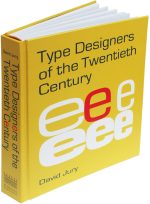
About Face: Reviving the Rules of Typography
author: David Jury
designer: Vince Frost
publisher: Rotovision, Brighton
date: 2002
The basic rules of typography are introduced within the context of current electronic information technology, which has made some rules obsolete. However, typography remains a fundamental element of graphic design, and the basics required by all graphic designers are presented here.

An interview by Agata Toromanoff
Discussing What is Typography and About Face
Published in One Hundred Great Books on Typography, 2016
In your book What is Typography? you stress the fact that typography is no longer restricted to the work of typographers. Is it now an area in which many designers work across many media?
In fact, What is Typography? explored the idea that we are all typographers – at least in the sense that we all use type; reading, writing, arranging it on screen and on paper, making temporary notices, signs, even shopping lists. The ubiquitous nature of type also means that there are many specialist areas of typographic study that are undertaken by people who not typographers as such... those working in semiotics, linguistics, semantics or graphology.
Looking at the way typography is designed and applied by untrained individuals on village notice boards and market stalls, in shops, restaurants and civic buildings, it is apparent that there is often an inherent sense of what is the appropriate way to 'say' something. Occasionally such material can have formidable power precisely because it comes directly from the person affected and untouched by a typographer. For example, in England fruit and vegetable market stall owners have their own particular way of writing the price lables for their produce. Another, very different example might be the huge lettered murals painted on the side of houses in Northern Ireland during the 'trouble'. By discussing and combining all modes of typographic use I hoped to answer the question, 'what is typography?
The last section of the book was given over to showing examples of work by practicing typographers. I didn't want to show the usual parade of renowned leaders in the field. Instead I chose as many different specialist facets of 'hard working' typographic design that I could – with the emphasis on the design of everyday items such as forms, signage, product manuals etc. (as well as projects that enabled a more expressive response). Such items demand he highest levels of typographic knowledge and craftsmanship precisely because their purpose requires that they be clear and unambiguous to everyone.
Given the fact that so many professionals are now involved in working with type, learning how to use it seems to be more important than ever. Should the education of designers include typography?
What is Typography? talks a lot about the democratic nature of typography, a situation greatly enhanced by digital technology. But I also emphasised that when type has a specific job to do it should be done by someone by someone with appropriate knowledge and technical skills. Every designer needs to know enough to know when they need to seek specialist help. Specialist knowledge is a resource that every designer needs to value and, most important, recognise when they don't have it.
Do you think the general public understand or care much about typography, whether in a newspaper, on the streets, or on a computer screen?
I am sure that for most people 'typography' is what they seen of shop fascias and advertising hoardings. Extended texts as seen in books, catalogues, manuals etc. is assumed by many to be something achieved automatically by the computer. This is regularly demonstrated at the first typography session I take with a new group of students. The most shocking revelation for students is that there is more to textual typography than simply deciding on the typeface and its size. There is an assumption that whatever appears on the computer screen must be correct – after all, a computer, that box of magic, is expensive and a highly sophisticated tool, right? Having to consider the different leading required by different typefaces in conjunction with line length is bad enough, but when the discussion eventually turns to kerning the look of disbelief on their faces makes it clear that very few people really understand how to make type function properly.
In your book What is Typography? you stress the fact that typography is no longer restricted to the work of typographers. Is it now an area in which many designers work across many media?
In fact, What is Typography? explored the idea that we are all typographers – at least in the sense that we all use type; reading, writing, arranging it on screen and on paper, making temporary notices, signs, even shopping lists. The ubiquitous nature of type also means that there are many specialist areas of typographic study that are undertaken by people who not typographers as such... those working in semiotics, linguistics, semantics or graphology.
Looking at the way typography is designed and applied by untrained individuals on village notice boards and market stalls, in shops, restaurants and civic buildings, it is apparent that there is often an inherent sense of what is the appropriate way to 'say' something. Occasionally such material can have formidable power precisely because it comes directly from the person affected and untouched by a typographer. For example, in England fruit and vegetable market stall owners have their own particular way of writing the price lables for their produce. Another, very different example might be the huge lettered murals painted on the side of houses in Northern Ireland during the 'trouble'. By discussing and combining all modes of typographic use I hoped to answer the question, 'what is typography?
The last section of the book was given over to showing examples of work by practicing typographers. I didn't want to show the usual parade of renowned leaders in the field. Instead I chose as many different specialist facets of 'hard working' typographic design that I could – with the emphasis on the design of everyday items such as forms, signage, product manuals etc. (as well as projects that enabled a more expressive response). Such items demand he highest levels of typographic knowledge and craftsmanship precisely because their purpose requires that they be clear and unambiguous to everyone.
Given the fact that so many professionals are now involved in working with type, learning how to use it seems to be more important than ever. Should the education of designers include typography?
What is Typography? talks a lot about the democratic nature of typography, a situation greatly enhanced by digital technology. But I also emphasised that when type has a specific job to do it should be done by someone by someone with appropriate knowledge and technical skills. Every designer needs to know enough to know when they need to seek specialist help. Specialist knowledge is a resource that every designer needs to value and, most important, recognise when they don't have it.
Do you think the general public understand or care much about typography, whether in a newspaper, on the streets, or on a computer screen?
I am sure that for most people 'typography' is what they seen of shop fascias and advertising hoardings. Extended texts as seen in books, catalogues, manuals etc. is assumed by many to be something achieved automatically by the computer. This is regularly demonstrated at the first typography session I take with a new group of students. The most shocking revelation for students is that there is more to textual typography than simply deciding on the typeface and its size. There is an assumption that whatever appears on the computer screen must be correct – after all, a computer, that box of magic, is expensive and a highly sophisticated tool, right? Having to consider the different leading required by different typefaces in conjunction with line length is bad enough, but when the discussion eventually turns to kerning the look of disbelief on their faces makes it clear that very few people really understand how to make type function properly.